


As shared in College Street News Issue 9, 2025, the College Curriculum Leadership Team (CLT) and the Learning and Teaching Team worked in two Action Teams (a Grade Scale Action Team and an Assessment Rubric Action Team) from January 2025 to develop a revised assessment rubric and grade scale for use in 2026. This work was in response to School Review feedback, together with our ongoing commitment to strengthening school culture. This work was salient to our 2025 Annual Action Plan, with Goal 1 being: “To improve student achievement and access to the curriculum by developing and implementing clear assessment rubrics in all year levels”. Additionally, marking changes to our Assessment Rubrics and Grade Scale was a clear priority from interviews with stakeholders.
Introducing Our New College Grade Scale
As part of our ongoing commitment to improving clarity, consistency, and fairness in assessment, the College has introduced a new assessment grade scale for students.
Why have we made this change?
Assessment results should clearly communicate how well a student has demonstrated their learning. Previously, assessment results were reported using percentages aligned to achievement standards. Because these standards covered a wide range of results, they did not always clearly indicate where a student’s achievement sat within that range. The updated grade scale has been introduced to:
- better reflect best practice in assessment and reporting
- help students and families more clearly understand what assessment results mean
- ensure that student achievement is recognised and communicated clearly and transparently.
What is a grade scale?
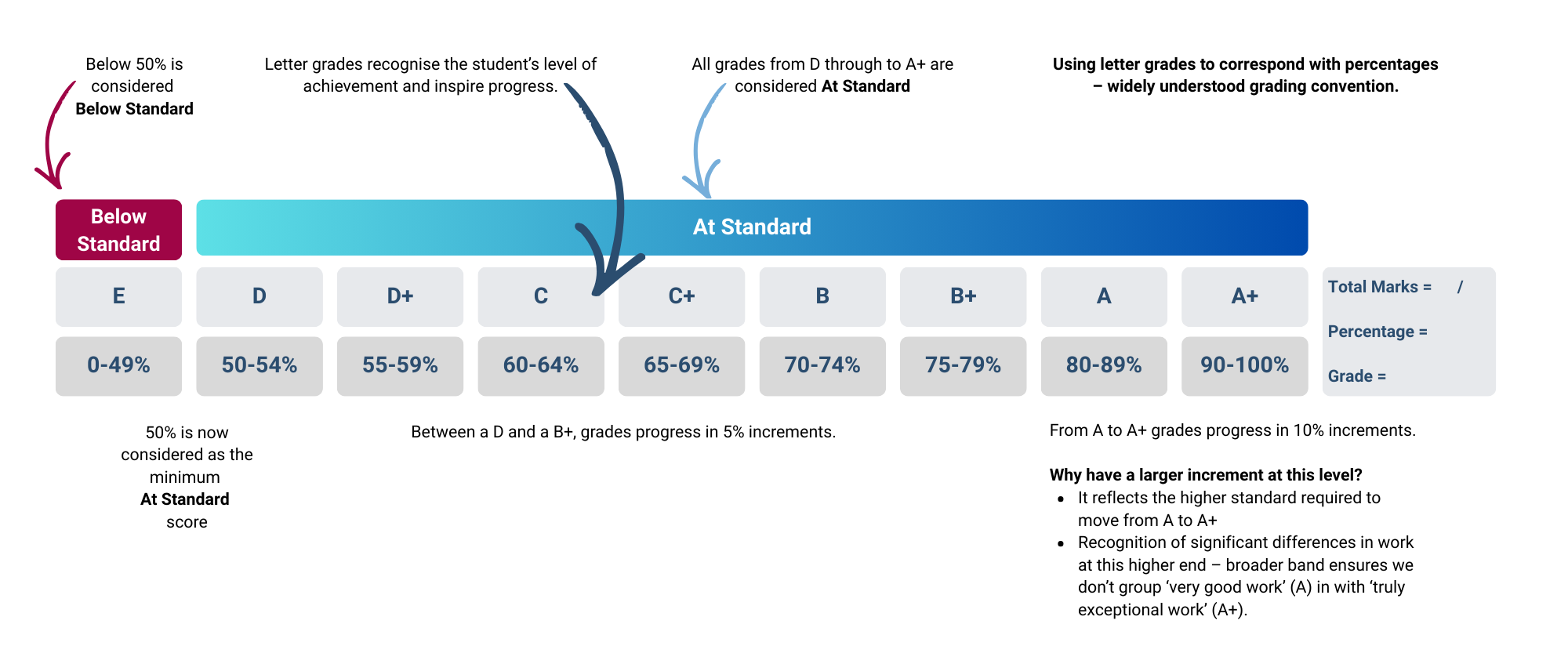
A grade scale shows how well a student has met the learning goals of an assessment task. Under the new system, students will continue to receive a percentage score, but this will now be accompanied by a letter grade. The letter grade directly corresponds to the percentage achieved and provides a consistent measure of achievement across subjects.
In simple terms, the grade scale helps students better understand what their result means, not just how many marks they earned.
What are the main changes?
- Percentage scores remain: Students will still receive a percentage result for assessment tasks.
- Letter grades are now included: each percentage result aligns to a clear letter grade.
- Letter grades now appear alongside percentages in SEQTA.
When does this take effect?
The new grade scale is already in place. Students and parents/carers will see letter grades alongside percentage scores when viewing assessment results in SEQTA.
Introducing our new Assessment Rubrics
Why have we made this change?
Alongside the introduction of the new College grade scale, we have also updated our approach to assessment rubrics as part of a broader focus on improving assessment clarity, consistency, and feedback for students. While the grade scale provides a clear summary of achievement, assessment rubrics describe the key knowledge, skills and attitudes being assessed and outline progressive levels of achievement, proficiency and sophistication. Rubrics play an important role in helping students understand what mastery and high-quality work look like, and how their learning is assessed, rather than focusing only on task completion or a final result.
What are the main changes?
The new rubrics have been developed to align closely with the College’s updated grade scale and to reflect best practice in assessment and reporting. Together, the grade scale and rubrics provide a clearer and more consistent picture of student achievement by showing both how a student performed overall and why they received that result.
These updated rubrics clearly identify the learning focus and links to curriculum of each assessment and describe levels of achievement, proficiency and sophistication using clear language. This helps students better understand expectations and supports more meaningful feedback, allowing them to clearly see strengths in their work as well as areas for improvement.
When does this take effect?
Classroom teachers will explicitly introduce and explain the assessment rubrics for their subject areas as assessment tasks are introduced this year. Teachers will guide students through the structure and features of the rubric, explain how it connects to task requirements, and highlight how it can be used as a learning and feedback tool throughout the learning and assessment process. This ensures students have a clear understanding of expectations before they begin an assessment and can use the rubric to support their learning.
We believe our new transparent rubrics will strengthen assessment consistency across the College, support clearer communication with students and families, and help students take greater ownership of their learning.